Showing posts with label Daniel Buren. Show all posts

Saturday, May 9, 2015

regula et vita

In his study of monasticism, The Highest Poverty, Giorgio Agamben identifies this phenomenon as an attempt to bring together a rule and a life, regula et vita, to a point at which they are indistinguishable. “What is a rule, if it seems to be mixed up with life without remainder ? And what is a human life, if it can no longer be distinguished from the rule ?”

This distinction, and near conjunction, might be useful for our purpose here. For just as the bringing together of rule and life was only imperfectly realised in monasticism, so the artists we discuss will lean to one side of the distinction or another. While Buren, Charlton and Toroni might be said to adhere to a rule as artists, there seems little or no impingement of the rule on life. For them, art is seen as a separate matter from personal history or comportment. For Kawara and Opalka, there is a closer conformity between art and life, and between a discipline in art and a form of life.

In both the religious and artistic context, a third term mediates between rule and life, the term work.  The monastics conform not only to a life of work and prayer, but this joint life is itself a work, an opus dei. For artists, of course, work is the making of art, and the art is specifically referred to as a work. The artists mentioned here might have the distinction of being the first to conceive of a work as a single practice, an opus, a life-long undertaking or discipline.


Although commitment to a single art practice has always been rare and is increasingly so, the bringing together of art and life, such as we see in Kawara and Opalka, brings their example closer to a contemporary concern for a practice of the everyday, for art to reach into and transform the quality of contemporary life. While artists are far from monastic (although communitarian ethics are much in evidence), a strong element in contemporary art does aspire to a practice of art in life, towards an infusion of one into the other, that might be “without remainder”.


Giotto, St Francis preaches to the birds, 
Basilica di San Francesco, Assisi

Saturday, August 31, 2013

One Is Enough


Having invented his Barre de petit bois ronde, Andre Cadere did not need to invent anything else. This one device was sufficient for his intention. It allowed him to intervene at any point in the gallery system and it allowed him to walk away at any time from the same system.

This situation is dramatised within the Barre itself: a sequence of colours is interrupted by one colour out of sequence, a context is established and then disrupted. With this, we have the full content of the Barres. They are not aesthetic objects: it would make no sense to compare them or to prefer one to another. In Cadere’s absence, the Barre remains emblematic of its maker’s freedom, of a critical intervention or distance.


In a similar way, Buren’s stripes were enough for his critical and installational purpose. He did not need a different device for each occasion. Indeed, to have used another motif would have been counter-productive. It would have introduced the possibility of comparison between works, or a chance for the exercise of aesthetic judgement. In Buren’s case, it is not the motif but its placement that is at issue, and for this purpose one motif is enough.


Monday, March 4, 2013

Stylized Painting


It's hard to think of a more detailed account of the uniqueness of painting as an activity than Nigel Wentworth's book from 2004, The Phenomenology of Painting. But after a few pages, it is apparent that Wentworth is essentially only invested in a specific kind of practice.     

In one section he grapples with the issue of what comprises an artistic gesture. He asks: why is it that painters come to paint in a specific way? How do we explain an artist's stylistic consistency, the inimitable mark of the artist's hand, evident in each work they create? He seems to have an artist such as Willem de Kooning in mind, whom he writes about in an earlier section of the book.


Willem de Kooning in his studio, East Hampton, 1964
Photograph Hans Namuth


Stylistic consistency is a mixture, Wentworth argues, of habitual actions involving “complex motor capacities” and “complex sensory discrimination”. 


But he is aware that this is true of any learned skill, like typing, for instance. So he introduces a qualification. Typists encounter highly similar situations all the time, such that you can say that you "know" how to type. But this is never true for painting. Practice at painting can lead to what he terms “mastery”, yet never “knowledge”. His rationale for this is that even “great masters” can make second-rate works. Strong art, on the other hand, involves the painter maintaining a careful interplay between his or her practical store of forms of behaviour learned from previously performed actions (we might call these habitual actions), and the very particular conditions encountered in this particular painting. A balance, in other words, between repetition and innovation. 

Wentworth's account is full of statements about what constitutes "good" art. For him, it is about maintaining a delicate equilibrium between, on the one hand, consistency and, on the other, spontaneity. This image of an artist walking a precarious tightrope stretched between the recognizably familiar and the innovative is often rehearsed within art criticism. But the trope is not relevant to Single Road artists.  

Wentworth might well be scathing of an artist such as Daniel Buren, for instance, who falls short of his criteria. He would probably call the work “stylized art”, because there is no vital, or risk-filled interaction between the artist and the work. “Stylized painting”, he writes, "is a form of sclerosis - closed, repetitive and boring.”


Daniel Buren
Detail in Actual Size of a Work Executed in 1966


Daniel Buren
Detail in Actual Size of a Work Executed in 1967


Daniel Buren
Detail of a Work Executed in 1968


Daniel Buren
Detail in Actual Size of a Work Executed in 1969


Daniel Buren
Detail in Actual Size of a Work Executed in 1970


Daniel Buren
Detail in Actual Size of a Work Executed in 1971


from Daniel Buren's contribution to the exhibition catalogue
Guggenheim International Exhibition, 1971

Monday, February 28, 2011

Introduction 3


Ad Reinhardt in his studio in 1966


It is important to be clear about what could be considered a single artistic practice, or an ongoing piece. After all, any modernist artists have developed a unique, signature style that has remained relatively consistent over a significant period of time, and still more artists would define their work as single-mindedly pursuing a very distinct field. But we are concerned with artists who have been explicit in declaring that any future art they make will conform to a set of designated criteria.

For instance, this excludes painters such as Agnes Martin - in spite of the fact that her mature work retains a remarkable formal consistency. This is because Martin never insisted that her art must include the formal elements that it does; hypothetically at least, it is possible that, had she had lived longer, she could have gone on to paint quite differently. For just this reason, her identity as a painter cannot be said to be reliant on any particular self-imposed conventions that would govern the appearance of her future art.


Likewise, a painter such as Robert Ryman has been very consistent in his approach over an equally long period of time. He has dedicated his career to exploring the fundamentals of painting as a medium, and it is this that seems to be his primary concern. In fact this, arguably, supersede any personal rules that he has established for his art.


It seems that artists such as Ad Reinhardt, Daniel Buren, Andre Cadere, Alan Charlton, Bernd and Hilla Becher, The Boyle Family, Roman Opalka, or On Kawara have adopted a different model for structuring their artistic output. They have defined in advance the nature of all their future art, and they seem committed to remaining 'true' to these rules over the course of a lifetime.


Ad Reinhardt, 'Black Paintings', 1966
Jewish Museum, New York


It is not the self-imposition of rules alone that interests us. Sol LeWitt is the artist most closely associated with this position, yet the prescriptions that define the nature of his art are specific to each separate work that he makes.


Clearly, the motivation of the artists in this category is varied, and these artist do not display the same level of consistency. Maybe, for instance, we shall need to retain a subsection for artists who have produced many different kinds of art, but who, nonetheless, have kept up a single, ongoing project.

One example that comes to mind is Douglas Huebler. In the early 1970s, he commenced his Variable Piece # 70, a work that consisted of an exceptionally long-term undertaking: it was to document photographically the existence of everyone alive.

Monday, January 31, 2011

Daniel Buren


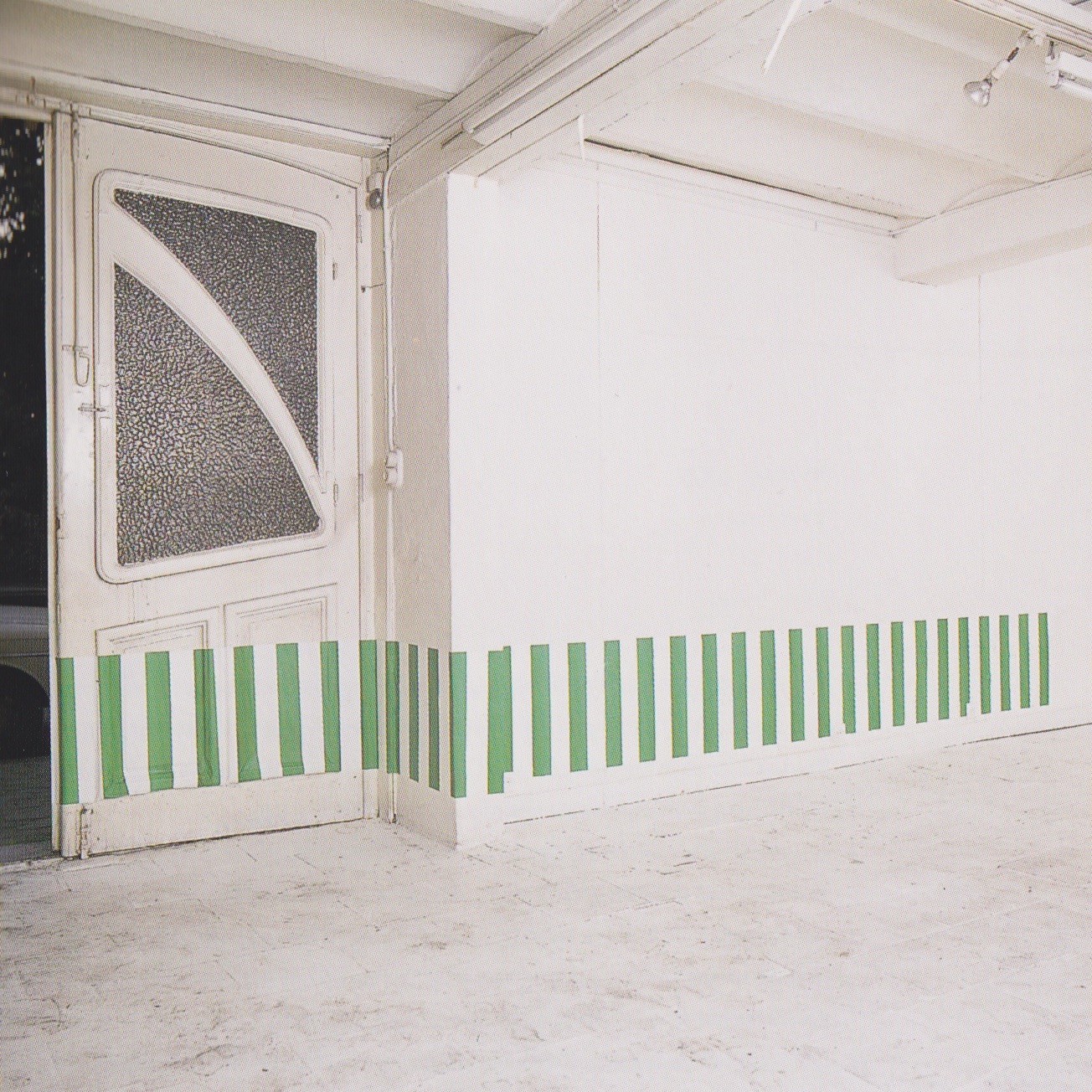
Daniel Buren's vertical bands of alternately white and coloured stripes have no internal composition, no painterly texture, no referential content or emotional impact, attempting a neutrality without intrinsic interest.

Conceived as 'a proposition', the stripes intervene in different locations, drawing attention to the location as public or private or institutional space, re-inscribed by the intervention.

To be successful in this revelatory purpose, the installation of the stripes should have a certain awkwardness, avoiding the suggestion of the ambient wallpaper they often resemble. A surprising, accidental or disturbing relation to their location, an intrusive quality, seems essential to their critical or indicative purpose.

Since the invention of the stripes in 1967, Buren's work has resolutely refused to develop.