Tuesday, October 28, 2014

Peter Dreher


Since 1974, the German artist Peter Dreher has made thousands of paintings of the same empty glass.

Under the general title ‘Day by Day good Day’, the paintings fall into two series, day and night, according to the time of painting. It is always the same empty glass, in the same place, painted life size.

The artist’s intentions seem to be both phenomenological and Buddhist; concerned with the attention that might be elicited from small differences and an emptiness or quiet that might be found at the bottom of such attention.

Unlike Opalka and Kawara, whose consistency is a possibility of conceptual art, Dreher’s single-mindedness perhaps arises from a daily practice of painting, and from the humility and gravity of the still life tradition.

The glass is empty but might be filled, or might have been recently emptied. It is a glass for water rather than whisky or wine. The poverty of the motif is an index of its seriousness, of what is at stake.

Addressed again and again, the object yields an infinite variety of lights and tones, of moods and reflections. The task for the viewer may be less one of comparison across the series than to be present without distraction on each occasion.


Nevertheless, all the paintings with this title are gathered, within the two series, into the one idea. The going on and returning, the again and again, the notion of a continuing practice, seem as essential, for both painter and viewer, as the act of looking.


Friday, June 13, 2014

James Howell


Studies in colour gradation were an integral component of Josef Albers’ teaching. It was a means of cultivating among his students a “more discriminating sensitivity” when it came to distinguishing between deeper and lighter hues. 

“We study gradation by producing so-called grey steps, grey scales, grey ladders”, he writes in Interaction of Colour. “They demonstrate a gradual stepping up or down between white and black, between lighter and darker.”


94.75 to 96.66
acrylic on canvas 
each 66 x 66 inches
October 2003


The painter James Howell has transformed this simple exercise in visual discrimination into a life project. He explores relational colour increments through the colour grey, which he works up from titanium white, ivory black and raw umber. They are mixed with the utmost care with a view to attaining the most equal modulations in shade that he can achieve. This has led Howell to delve deep into colour chemistry and to rely on computer aided technologies. This has been especially necessary in order to ensure that the temperature of the grey remains constant, in spite of the shifts in shade he might wish to apply.

s10, Set 91.14, 7.5.99
acrylic on canvas
40 x 40 inches


In earlier works, he painted a series of grey tones on separate aluminium sheets. But in his latest series, Howell paints horizontal bands of grey on a single, square canvas, always setting the lightest shade at the top, and the darkest at the base. These works are distinguished by the tonal range they depict. Some are calibrated so as to expose an almost imperceptibly narrow degree of variation, while in others the parameters are set further apart.

Set 68.98 12/27/94 
Acrylic on .25 honeycomb aluminium 
33 x 33 inches


At first glance, these works look monochromatic and almost blank. It is only gradually and from close up that the narrow bands become perceptible, and we come to notice the artist’s delicate, meticulous brushstrokes. Gradually the paintings' underlying order and rationale reveals itself. But no sooner do we have a sense that we have grasped the nature of this artistic project, and we start to enjoy the heightened sensation of knowing that our eyes have become attuned to these infinitely subtle gradations, then something strange happens.

The work ceases to feel like a mere rigorous optical exercise, and emerges as an unending, poetic meditation on the essence of the opaque.

Wednesday, March 19, 2014

Reinhardt Over and Over Again


Alistair Rider, 'Reinhardt Over and Over Again', published in The Brooklyn Rail Ad Reinhardt Centennial, 1913-2013 (December 2013-January 2014), p. 54.

Feeding Plans II

On her 22nd birthday in March 2001, the English artist Ellie Harrison commenced a photo-diary of everything that she ate over the course of one year. The project was called Eat 22, and is now in the collection of the Wellcome Institute in London.

Image: 178
Date: 8 April 2001
Time: 13:13
Food: banana
Location: studio, Nottingham


Harrison established strict rules for the work:

'All food must be photographed before it is eaten.
All food photographed must then be consumed.
Any additional food eaten, not included in the original photograph, must be photographed separately (second helpings, extra portions, desserts etc).
In places where photography is prohibited (cinemas etc), food must be photographed prior to entering or not consumed at all.
In the case of party food (crisps in bowls etc), wherever possible all handfuls should be photographed.
Liquid is exempt, however drinks which are considered to to have some solid content should be photographed (soups etc).
Chewing gum is exempt as it is not consumable.
If any of these rules are broken, details must be recorded in the log.'


Image: 903
Date: 10 September 2001
Time: 19:37
Food: 2 baked potatoes with cottage cheese, 3 veggie sausages, slices roasted squash
Location: kitchen, Ealing

Harrison lists 1640 photographs on her web description of the work, Eat 22.

Eat 22 is subtly different from Knowles' Identical Lunch. For Knowles, consistency is a means of turning attention to ordinary everydayness, and a meal eaten is treated as suitably representative of this. The focus is less on recording every single lunch that she consumes (although the fact that we are led to believe that the lunch is 'identical' invites us to entertain the idea that - like Andy Warhol's soup-based midday meal - Knowles enjoys the same soup and tuna sandwich daily, and, following from this, that the artwork embraces every lunch the artist ever consumes).

In contrast, Harrison's project attests to a new digital era, in which data collection and data logging has become a simple and widely-available technology. Harrison's Eat 22 links eating with picture taking: the camera and computer become as essential as the crockery and cutlery.

A historical study could be written about the emergence of works of art that grow at a regulated pace. Maybe its beginnings date back to the late 1960s, and to the rise of conceptual art and performance-based practices. Almost always these are durational or long-term projects. They are distinguished by the fact that they develop accretively, unregulated by artistic inspiration or creative urges. Instead, they expand according to more ordinary factors, such as the ticking of a clock, or the needs of the stomach.              


Feeding Plans I

In the early 1970s, the Fluxus artist Alison Knowles prepared an event score which she called The Identical Lunch. It was based on her experience of consuming her daily meal at Riss Restaurant at 242 Eighth Avenue, Chelsea, New York.

The Identical Lunch comprises "a tunafish sandwich on wheat grass toast with lettuce and butter, no mayo, and a large glass of buttermilk or a cup of soup". Knowles invited many of her friends to participate in this performance, and she documents the records of their experiences in her 1971 publication, 'Journal of the Identical Lunch'.


Reading through the diary-like entries that comprise the book, it quickly becomes apparent that the only element that remains even loosely identical is the description of the meal as it appears as a meal option on a restaurant menu. 

The journal entries record the wide number of variables that the score permits, and which are contingent on the venue, the chef, the food products themselves, the waiter service, the mood of the performer, and so on. 

One entry by Jim Maya in Knowles' publication succinctly summarizes what other contributors also imply:

'The identical food demands little or no thought:
The surrounding activities take all your thought:

The waitress, her hair, her lips, the napkins,
Their embossments or lack of embossments.
The stools, the chairs, the heat.

When you've finished --
You hardly know you've eaten.'

Riss Restaurant closed long ago, but to this day Knowles continues to perform Identical Lunch in various locations.

Monday, December 16, 2013

James Howell and Alan Charlton at Mies van der Rohe Haus, Berlin


During 2013 the Mies van der Rohe Haus in Berlin has organized a series of exhibitions on the colour grey. The fourth, Haupsache Grau: Konstruiertes Grau (Constructed Grey) features works by Josef Albers, Alan Charlton, Andrzej Gieraga, Hans Jörg Glattfelder,  James Howell, Caro Jost, Arnulf Letto, Dennis Meier, Gerold Miller, Otto Reitsperger, Sibylle Wagner, Peter Weber and Susan York.

Wita Noack's essay on the exhibition concept


Tuesday, October 22, 2013

Cecilia Vissers, Time and Tide, Summerhall, Edinburgh, 11 October - 22 November 2013


Cecilia Vissers exhibits eight sculptures at Summerhall, Edinburgh.

Blacksod Bay, a two-part work from 2010 in hot rolled steel, currently hangs in the stairwell.


For further information, including a short video, see the Summerhall webpages

Saturday, August 31, 2013

One Is Enough


Having invented his Barre de petit bois ronde, Andre Cadere did not need to invent anything else. This one device was sufficient for his intention. It allowed him to intervene at any point in the gallery system and it allowed him to walk away at any time from the same system.

This situation is dramatised within the Barre itself: a sequence of colours is interrupted by one colour out of sequence, a context is established and then disrupted. With this, we have the full content of the Barres. They are not aesthetic objects: it would make no sense to compare them or to prefer one to another. In Cadere’s absence, the Barre remains emblematic of its maker’s freedom, of a critical intervention or distance.


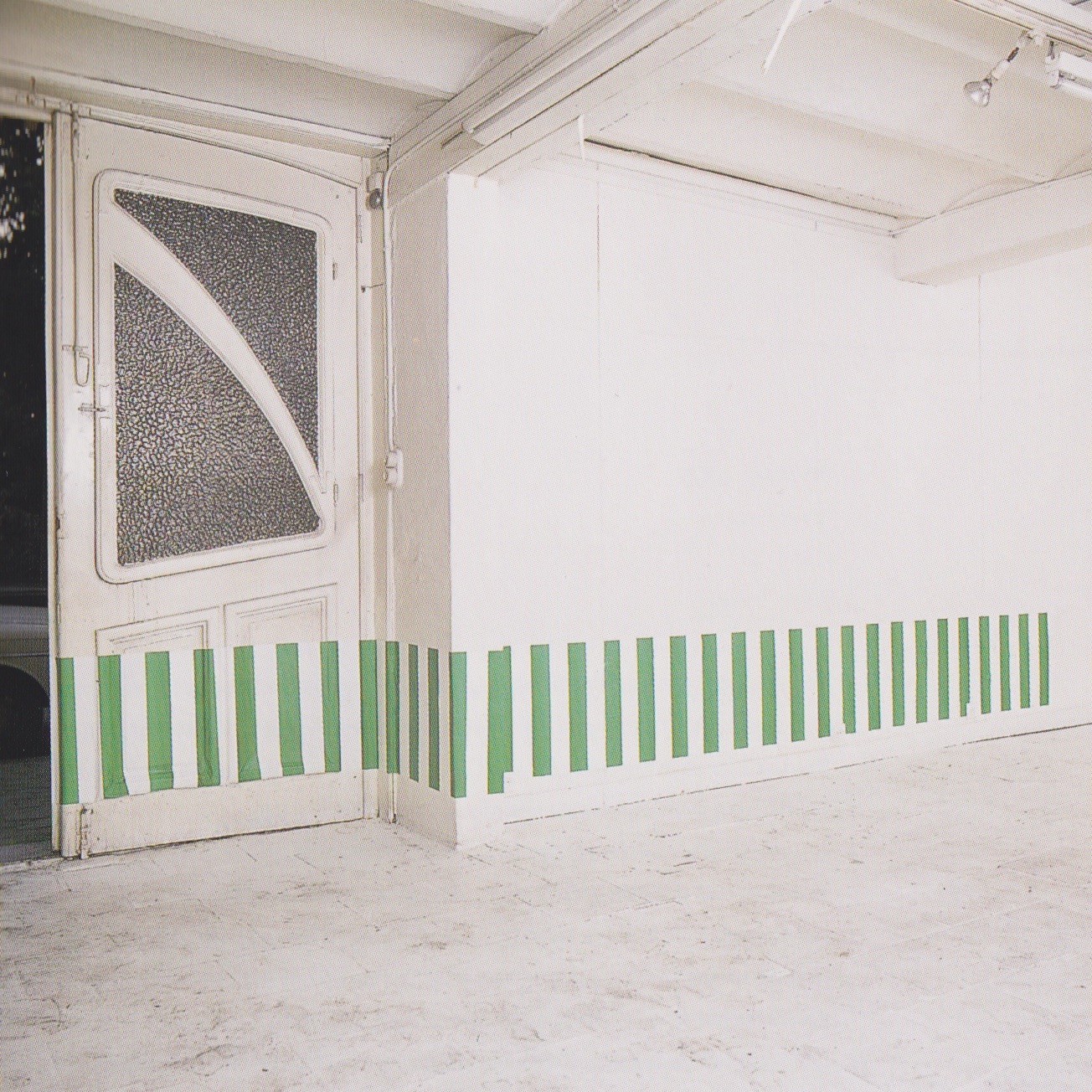
In a similar way, Buren’s stripes were enough for his critical and installational purpose. He did not need a different device for each occasion. Indeed, to have used another motif would have been counter-productive. It would have introduced the possibility of comparison between works, or a chance for the exercise of aesthetic judgement. In Buren’s case, it is not the motif but its placement that is at issue, and for this purpose one motif is enough.


Friday, June 14, 2013

a single road


"For in the end we all - even I - live by eating, drinking, sleeping.
Those are the fundamental truths, but one has to pay for them.
I've worked a lot. From this point of view, I don't wish to deny
the success of my works. I have a good conscience; I've written
thousands of slips of paper. In the sense of this responsibility -
work, conscience, fulfilment of duty - I'm no worse a worker
than anyone who has built a road."

- Hanne Darboven
quoted in Hanne Darboven, Cultural History 1880-1983, 
by Dan Adler, Afterall Books 2009


Wednesday, May 29, 2013

Why Not


Why do one thing all your life, when you might do different things, as many as you like, whenever you feel like it ?

It may be that this question is no more applicable to art than it is to any other area of life. Why be married and faithful when you might have any number of sexual partners? Why stay in one job when you might try others, or live in one place when you could move or go travelling ?

Such questions are crude, marked by exclusions and failure of empathy. They assume choice as a right and take consumption as the model for agency. They are also self-defeating, since, if choice is open, the decision for singleness or consistency will be as legitimate as any other.

No doubt mistrust of a single practice is the legacy of romantic notions of the freedom of the artist, of an effortless creativity, a constant self-invention. Investment in the idea of the artist as exception remains strong in a society where room for manoeuvre is still limited.


Why continue to make one form of art when you might develop or invent different practices at different times ? While such a question might begin in a genuine puzzlement, it would be unreasonable to press it beyond a certain point. Where art is concerned, interrogation should always be secondary to a genuine effort of understanding, to an attempt to inhabit the problems, to see a practice from the inside, with some sense of its advantages as well as its restrictions.


Sunday, April 21, 2013

Cadere on (non) development


Lynda Morris  I was very struck by your response to a question one of the Slade students asked you about the development of the work.

Andre Cadere   There is no development in the work. It is a method I made six years ago. It is a very precise method and it is always the same method. Each piece is different. It is not good to use the word "stick". Each "round bar of wood" is different. Each bar I make is included in a system that was there from the beginning, with permutations in the order of the colours, and one deliberate mistake (laughing). So in fact what I am doing is like a world constellation of round bars of wood. I do this and I do that in the making but in fact they are included in a platonic sense.

Lynda Morris  So the development in the work is not in the craft of making the bar of wood or the permutation of the colours, but in the situation where you present it ?

Andre Cadere   Exactly.  My art is the situation of my work in the art world. I am only interested in the art world because the work in the street is always the same. In the street there is no development because people in the street react in the same way today as they did six years ago and as they would react 20 years into the future. Maybe it will change as I grow older and older, maybe when I have white hair (laughter) but it is not certain.
     In the art world my work has changed in a very interesting way in the last five or six years. Even in 1972 at Documenta people asked me "What is this ?" I replied "This is my work and I exhibit it in this way. I bring it with me." People made fun of this and they said: "In six months you will become serious again." Six months later it was the same, I just continued for one year, two years and three years, and so the art world started to have different feelings about my work. And people started to ask: "What does he want, why is he always at openings and art fairs ? Does he want to show his work in galleries and in museums ?" And now in fact I have had a lot of shows in galleries and with museums and I continue to work with the round bar of wood. But I think the art world still does not really understand my work.


from Documenting Cadere 1972-1978, Modern Art Oxford/ Koenig Books 2013  

Friday, April 12, 2013

The Hedgehog and the Fox


'There is a line among the fragments of the Greek poet Archilochus which says: "The fox knows many things, but the hedgehog knows one big thing."

Scholars have differed about the correct interpretation of these dark words, which may mean no more than that the fox, for all his cunning, is defeated by the hedgehog's one defence.

But, taken figuratively, the words can be made to yield a sense in which they mark one of the deepest differences which divide writers and thinkers, and, it may be, human beings in general.

For there exists a great chasm between those, on one side, who relate everything to a single central vision, one system, less or more coherent or articulate, in terms of which they understand, think and feel - a single, universal, organising principle in terms of which alone all that they are and say has significance - and, on the other side, those who pursue many ends, often unrelated and even contradictory, connected, if at all, only in some de facto way, for some psychological or physiological cause, related by no moral or aesthetic principle.

...The first kind of intellectual and artistic personality belongs to the hedgehogs, the second to the foxes...'

Isaiah Berlin, The Hedgehog and the Fox: An Essay on Tolstoy's View of History (1953/78)


Carl Andre, Herm, 1960 (realised 1978)


'I find that the more I feel that I'm capable of doing the things I want to do, the narrower my scope is. I feel far more concentrated. I'm definitely a hedgehog, as in the metaphor of Archilochus, the way someone like Bob Morris is definitely a fox. The fox knows many things and the hedgehog knows one thing very well. This is not a value distinction at all. Rather, it's a difference in temperament between different kinds of people.'

Carl Andre, interview with Patricia Norvell, 1969


Andy Warhol, Superman, 1961


By contrast to Andre, Warhol most certainly was a fox.

'If an artist can't do any more, then he should just quit; and an artist ought to be able to change his style without feeling bad. I heard that Lichtenstein said that he might not be painting comic strips a year or two from now - I think that would be so great, to be able to change styles. And I think that's what's going to happen, that's going to be the whole new scene.'

Andy Warhol, interview with Gene Swenson, 1963